
You have been invited
Someone wants to talk privately
They sent you an Ombra code. Ombra is messaging with no account — no phone number, no email, nothing to sign up for.
You have been invited
They sent you an Ombra code. Ombra is messaging with no account — no phone number, no email, nothing to sign up for.
One key. You own it, you hold it, it is never shared.
There is no account to sign up for. Your messages are locked before they leave your phone and only the recipient can open them.
@rae
NOTHING
No deletion promise. No zero-log policy. We physically do not ask for or keep anything from you.
What a normal service holds
2,481,900
1,336,204
984,517
1,204,388
77,412
9,610,733
5,290,164
312
* There is one thing we hold, and it is not about you.
A message on its way
If the recipient's phone is off, we hold the message until it can be delivered — for up to 14 days. It stays fully encrypted the whole time, and opening it needs keys that exist only on your phone and theirs. If it is not collected within 14 days it is permanently deleted, and the app tells you it never arrived.
How it works
GENERATING ON THIS DEVICE
omb-7F2Q-MK94-XBUT-RV6P-ZD3N-LC8W-HA5
Your address is made from your key. Nothing is registered, and nobody is asked. There is no password, because there is nothing to log in to — nothing to reset, and nothing anyone can phish out of you.
Every chat shows you that it is encrypted and that both sides hold keys. Open the recipient's name to see their address and the state of the connection.
The keys live on the two phones talking, and they change with every message. A key taken today will not open what was said yesterday.
Inbox
Pricing
Not a trial, and not a cut-down version. Everything that keeps your messages private is free and always will be.
0
Free, forever
Upgrades
Short name
€29
Bigger files
€12
Five short names
€99
What happens when you pay
Paying gives you a random, one-time token. You redeem it in the app, and redeeming simply switches the upgrade on.
You do not choose a name when you order, and you do not choose one when you redeem. The token is not stored after it is used, so once it is redeemed there is nothing recording what it became.
The card company knows your card, the same as any shop. What it cannot know — and what we cannot know either — is which name or which upgrade the payment turned into. There is no account for it to attach to, and the token carries nothing back to the purchase.
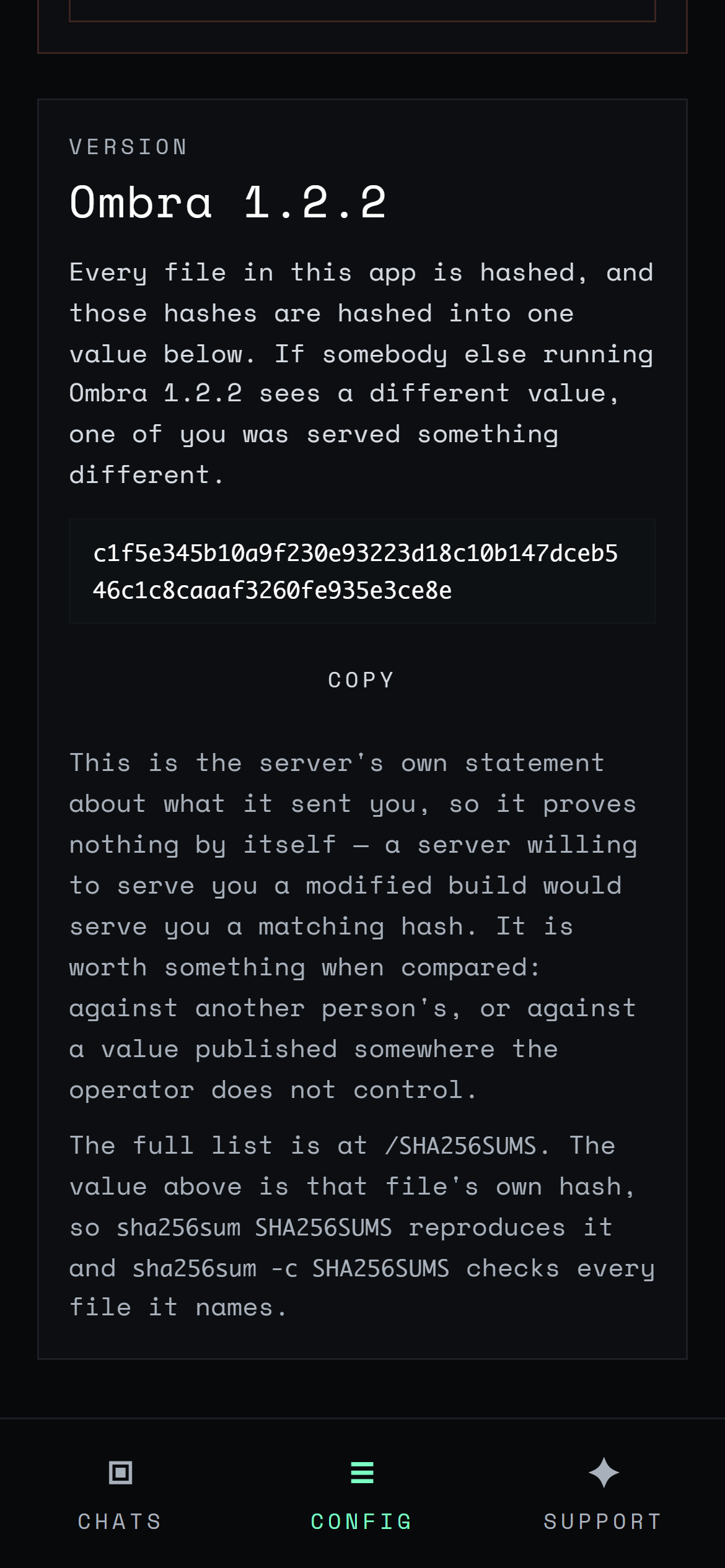
Ombra runs in your browser, which means we hand you the app every time you open it. In theory we could hand one person a different one.
So the app shows a code for the exact version you were given. Compare it with a someone else running the same version. If the codes differ, one of you got something else — and that is the thing you would otherwise never spot.
Your backup is your recovery
One phone at a time
No outside review yet
Get it
The installed app has its own storage. A key made in a browser tab will not come across, so add it to your home screen before you start.
iPhone or iPad
Android or computer
That is the whole setup. No forms, no waiting, no codes by text.